

News
Safeguarding Forests and Community Rights in Malaysia’s Sustainable Finance Taxonomy
Blog originally published by SAM
Below are SAM’s comments on the Proposed Malaysia Taxonomy for Sustainable Finance: Safeguarding Forests and Community Rights in Malaysia’s Sustainable Finance Taxonomy
Why financial institutions play a critical role
The proposed Malaysia Taxonomy for Sustainable Finance is a step in the right direction, but it’s not enough. As it stands, the proposed framework misses the mark on protecting our forests and biodiversity and most importantly safeguarding the rights of the indigenous peoples and local communities who call these forests home.
Sahabat Alam Malaysia (SAM) took part in the public consultation on the “Call for Feedback: Malaysia Taxonomy for Sustainable Finance”, and submitted its feedback on 14 April 2026 to the Malaysia Taxonomy for Sustainable Finance Taskforce. The taskforce is co-chaired by Bank Negara Malaysia (BNM) and Securities Commission Malaysia (SC), under the Joint Committee on Climate Change (JC3)). SAM’s comments draw on its Regulating Finance for Forests and Community Rights in Malaysia (February 2026) report.
Malaysia is one of the most biodiverse places on the planet, and so our taxonomy should put local priorities and community concerns first. For years, civil society groups have raised concerns over the lack of accountability surrounding high-risk projects, yet funding for environmentally destructive activities continues largely unchecked. The imbalance is stark. A report shows that private financial flows to activities that harm biodiversity is much greater than public investments in conservation.
By choosing what to fund, financial institutions play a direct role in shaping outcomes for forests, biodiversity, and indigenous peoples’ rights as long-standing stewards of the land. This is where a ‘sustainable taxonomy’ comes in – it’s a system that defines which economic activities and investments are truly ‘sustainable.’ We present an overview of our assessments and comments on the proposed Malaysia Taxonomy for Sustainable Finance, as well as recommendations for each of our concerns below.
Key gaps and recommendations on the proposed Malaysia Taxonomy
Ensure meaningful consultation and representation of CSOs and communities
The Call for Feedback document directs all 30+ questions solely to financial institutions, focusing on data and implementation issues while overlooking safeguards for forests and Indigenous and community rights.
This is concerning because as sustainable finance gains prominence, NGOs and affected communities must be meaningfully included in the process..
We recommend that the Taskforce holds dedicated consultations with indigenous peoples and local communities, especially Orang Asli and Orang Asal and requires financial institutions to incorporate civil society organisations’ (CSOs) and communities’ inputs in due diligence for forest-risk sectors. The Taskforce should formally include representatives from grassroots CSOs and community-based organisations (CBOs) – not just large international conservation based organisations only.
Strengthen social safeguards by assessing both project and entity levels, with mandatory FPIC
A key concern is that “social aspects” are assessed at the entity level rather than at the project level. This allows companies to access “green” financing based on broad human rights policies, even when specific projects violate community rights. Free, Prior and Informed Consent (FPIC) is never a requirement but only a factor to be “considered where relevant”.
The Malaysia Taxonomy should also include social considerations beyond the Social Aspects outlined in the draft, specifically on the issue of indigenous customary land rights and FPIC. In two of our key publications on indigenous customary land rights in 2016 and 2019, as well as many other publications and articles since the 1980s up until today, the violations of indigenous customary land rights are a systemic issue in the country. Drivers of such violations include logging, monoculture plantations, mining and construction of infrastructure such as large dams, roads and airports. Such a view was also verified by the Report of the National Inquiry into the Land Rights of Indigenous Peoples published by the Human Rights Commission of Malaysia (SUHAKAM) in 2013.
Today, more than ten years after SUHAKAM’s 2013 publication of its report on its national inquiry process on the indigenous customary land rights in Malaysia, its 18 recommendations from the report have yet to be implemented by the federal and state authorities.
FPIC is now becoming central to discussions in governance and sustainability. The critical role of indigenous peoples and local communities in protecting tropical forests and preserving ecosystems is increasingly recognised around the world and the financial sector needs to take steps in formulating a robust policy and understanding in this regard. As such, FPIC should be a mandatory principle for banks to strictly monitor and enforce and cannot be dismissed entirely in the Malaysian sustainable taxonomy.
We recommend that, to strengthen the framework, social safeguards must be assessed at both entity and project/activity levels for land-intensive sectors. FPIC must be an explicit requirement for any activity affecting indigenous peoples or local communities. Financial institutions should also be required to establish a grievance mechanism on environment and human rights issues based on the effectiveness criteria of the UN Guiding Principles.Further, it is also recommended that Malaysian Taxonomy require compliance with the International Labour Organisation (ILO) core conventions, Organisation for Economic Co-operation and Development (OECD) Guidelines for Multinational Enterprises, United Nations Guiding Principles on Business and Human Rights, and United Nations Declaration on the Rights of Indigenous Peoples (UNDRIP). By doing so, Malaysia Taxonomy will provide a higher level of human and labour rights protection and will become better aligned with other national and supranational taxonomies, providing for more interoperability. On top of that, consideration should be given to establishing a more comprehensive taxonomy treatment of social issues, either through a dedicated social section within the Malaysian Taxonomy or a standalone social taxonomy. For a megadiverse country like Malaysia, any positive social finance framework must prioritise indigenous peoples and local communities living at the frontlines of our ecosystems. To align capital with genuine environmental and social justice, a Malaysian social taxonomy should incentivise sustainable financing that secures customary land tenure, funds grassroots ecosystem restoration and supports community-led ecotourism, agroecology and agroforestry — coupled with rigid, activity-level safeguards against land grabs.Given the 2030 GBF targets, the taxonomy should consider an implementation timeline – one that gives time to build capacity while making sure harmful financing and/or investing is eventually restricted: e.g., 18 months to begin reporting on forest-risk exposures, then a mandatory deadline to implement matters like FPIC assessments, finally prudential penalties/fines for Red activities like peatland conversion. Phased implementation should not delay social safeguards given how significant the harm to communities invariably is in their absence. Any guidance resources should be co-developed with CSOs and indigenous peoples and local communities.
Develop a Malaysia-specific exclusion list
The ASEAN Taxonomy’s Red List automatically classifies certain activities as Red, but it excludes agriculture, forestry or land-use activities. As such, there is no clear “red” classification for deforestation, peatlands conversion, encroachment on indigenous customary lands — activities that contradict Malaysia’s climate commitments, Global Biodiversity Framework obligations and the No Deforestation, No Peat and No Exploitation (NDPE) standards.
We recommend that the Malaysia Taxonomy should be strengthened by introducing a national Red List, building on the Value-based Intermediation Financing and Investment Impact Assessment Framework (VBIAF) exclusion list, and recognising Environmentally Sensitive Areas (ESAs) under the National Physical Plan. “Protection of Health Ecosystems and Biodiversity (EO3)” needs to be better defined. At the minimum, it should recognise ESAs, which are clearly mapped in the National Physical Plan (NPP) and have been agreed to by both the federal and state governments and have been assigned rankings to limit what activities are allowed and what are not. For example, a site with an ESA Rank 1 under the NPP prohibits development, agriculture or logging except for low-impact nature tourism, research and education purpose activities. Putting these restrictions in place would send a clear signal that financing should not support forest and peatland conversion, projects without verified FPIC, or new plantations on forested land. It would also bring the framework in line with Malaysia’s biodiversity commitments and the National Forestry Act amendments.
Remedial actions should be independently verified with clearer guidance
The Malaysia Taxonomy aims to unify existing principle-based frameworks but what it does is, it ends up emulating the ASEAN Taxonomy’s accommodating stance towards ongoing harm through broad Amber transition tiers based on non-verified remediation plans. Five years under Amber (Tier 2) is often the length of a financing period itself, so by the time reclassification occurs, the financing will have been disbursed and the damage done.
When it comes to forests and biodiversity, the priority must be clear, protect what still stands. Conserving intact ecosystems is far more effective and far less costly than trying to restore them after they have been destroyed. More often than not, destroyed ecosystems cannot be restored to their original state. This is a basic principle that the taxonomy should spell out explicitly. Leaving “remedial actions” vague risks normalising a damaging “destroy first, offset later” approach, especially in the absence of clear safeguards. Likewise, talk of “transition” measures becomes confusing and misleading without a clear exclusion list that defines which activities are simply off‑limits.
We recommend that the 5-year Amber window be reduced for activities in biodiversity-critical sectors (agriculture, forestry and fishing) as well as land use. Remediation plans should require independent verification, including affected communities and CSO consultation. Activities that cause irreversible harm (for example deforestation and peatland drainage) should not be eligible for Amber classification. They should automatically fall under Red.
Need to focus on limiting greenwashing
The ASEAN Taxonomy relies on voluntary adoption, with no enforcement provisions. As far as Malaysia’s offshoot is concerned, there is no proposed penalty for misclassification, no sanction for financing Red-classified activities and no mechanism to hold financial institutions accountable for biodiversity or social harm. Although the shift from a purely principles-based approach (i.e., subjective self-assessment) to Technical Screening Criteria (TSC) is an upgrade, the TSC for Agriculture, Forestry and Fishing still allow national and international industry certifications (like MSPO/RSPO and MTCS/FSC/PEFC) to automatically grant activities a Green (Tier 1) classification, ignoring the schemes’ inherent limitations. They are inadequate as proxies for compliance and have historically failed to prevent deforestation, peatland destruction and rights abuses.
We recommend that the implementation of Malaysia Taxonomy must be accompanied by binding policies that include: (a) penalties for misclassifying activities or deliberately obscuring biodiversity or social risks; (b) prudential measures (such as higher capital charges) for concentrated exposure to Red-classified activities; and (c) a public complaints mechanism for affected communities to report greenwashing. Malaysia Taxonomy should not accept certification as a sufficient standalone criterion for “Green” classification. At minimum, certified activities should require supplementary independent verification of compliance with NDPE. Sector-specific due diligence guidance building on the VBIAF Sectoral Guides should be made mandatory rather than advisory, with specific quantitative targets (e.g., no-deforestation cut-off dates and full traceability requirements).From SAM’s perspective and Forests & Finance, a practical guidance would be for BNM and the SC to support financial institutions in establishing a grievance mechanism on environmental and human rights issues based on the effectiveness criteria of the UN Guiding Principles. This should be made mandatory for all financial institutions. Affected communities have the right to know who is financing activities in their area, and any claims from financial institutions must be independently verified and fact-checked against realities on the ground. Policies are more likely to be breached and practices greenwashed if affected communities are not made aware of these financial or supply chain links.At an industry level, the regulators should explore establishing a localised registry where CSOs and communities could log land disputes, unverified FPIC claims and deforestation alerts. The same platform could also be used for reporting greenwashing directly to regulators (as an alternative to navigating opaque complaint systems of individual banks). However, such a mechanism should not shift the burden of monitoring and escalation from companies to NGOs and communities, but rather reinforce the companies’ own due diligence responsibilities.
An overview of SAM’s assessment of the Malaysia Taxonomy
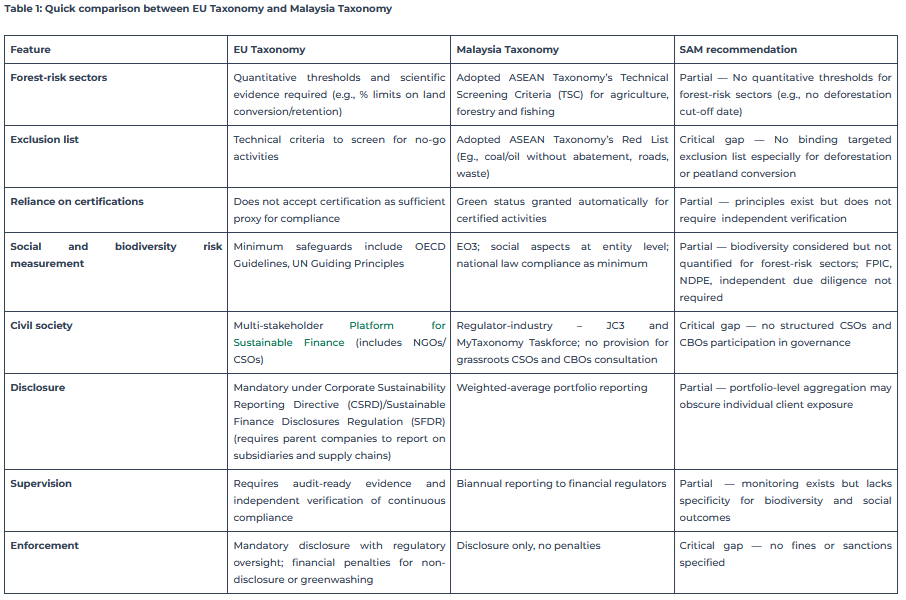
We compared Malaysia’s draft taxonomy against the EU framework to gauge where we stand. While the two operate in very different national contexts, particularly given the EU’s developed economy setting and distinct challenges, this comparison helps us identify critical gaps and strengthens our ability to align with the highest possible standards to safeguard our forests and uphold community rights.
Table 1: Quick comparison between EU Taxonomy and Malaysia Taxonomy
Closing the accountability gap: enforcing Malaysia Taxonomy
While national laws and illegal logging are referenced as minimum safeguards, financing such activities is currently treated mainly as a disclosure issue. To ensure the Taxonomy drives real change and not just labelling, regulators should introduce mandatory, binding rules for the protection of forests and community rights, as recommended in SAM’s regulating finance (February 2026) report.
Further, weighted-average or aggregated reporting could dilute exposure to harmful activities within diversified portfolios. Instead, disaggregated reporting by forest-risk sector should be mandated and transaction-level data on forest-risk clients, including parent companies and intermediaries should be disclosed.
It should be mandatory for financial institutions to establish a grievance mechanism on environment and human rights issues based on the effectiveness criteria of the UN Guiding Principles to strengthen transparency. Disclosures across supply and financing chains should also identify specific projects and involved parties. Affected communities should have the right to know who is financing activities in their area. Without such transparency, policy commitments are more easily undermined and greenwashing risks increase, particularly when communities are unaware of the financial links behind local activities. These measures can be embedded in existing regulations as well as impending nature risk guidance and linked to EIA approvals for verification.
Financial institutions should also put in place a policy to do on-the-ground checks, especially when there are indigenous peoples and local communities or reported land conflicts. This is to find out whether communities have been properly consulted, FPIC principles used and their rights including to say “No” have been respected. These were some of the expectations among the participants of the Forests & Finance Symposium 2025 organised by SAM.
Finally, without regulatory backing, the Malaysia Taxonomy also risks repeating the limitations of earlier frameworks. To make it effective, financial regulators should build on existing laws against misleading disclosures to impose sanctions on institutions that misclassify activities or obscure biodiversity and social risks.