

News
Illegal gold mining in Cameroon
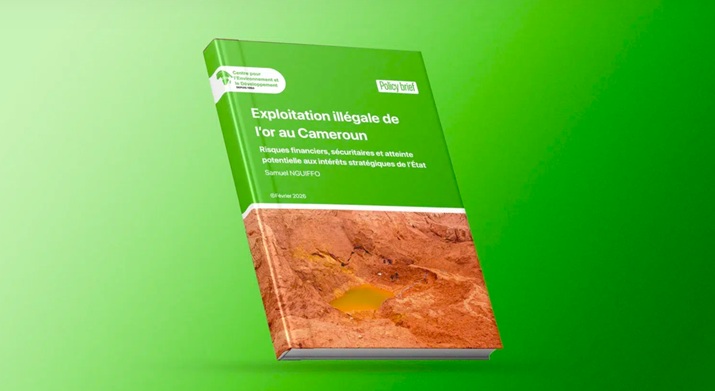
The policy brief was originally published by CED
The CED policy brief Exploitation illégale de l’or au Cameroun highlights a sector in which the state’s ability to regulate extraction, production and trade remains limited. Published in June 2026, the brief examines the scale and consequences of illegal gold mining in Cameroon, including weaknesses in oversight, traceability and the control of gold production and commercialization. Its relevance to financial regulators lies in the fact that gold is not only a mining product: it is also a high-value, highly liquid commodity that can move through informal and opaque commercial and financial channels. Recent government action has likewise focused on restructuring the artisanal and semi-mechanized mining sector and strengthening gold traceability.
The brief’s findings point to important regulatory questions around traceability and formalisation. Where gold is extracted or traded outside the formal regulatory system, it becomes more difficult for authorities to establish who is producing it, where it comes from, how much is being produced and where it ultimately goes. This has implications beyond the mining regulator. Financial-sector authorities have an interest in ensuring that the proceeds of gold sales do not enter the formal financial system without adequate information about their origin, ownership and underlying economic activity. The broader national risk-assessment framework has already identified the gold and precious-metals sector as vulnerable to money laundering, including through illegal mining networks, corruption and weaknesses in controls over the origin of funds.
This makes financial supervision an important complement to mining regulation. Effective regulation of the gold sector cannot depend solely on inspections of mining sites or the issuance of mining permits. It also requires visibility over the commercial and financial chain connecting miners, collectors, buying offices, processors, exporters and other market participants. Financial regulators therefore have a role in ensuring that regulated financial institutions apply appropriate risk-based controls to activities and transactions associated with the gold trade, identify suspicious patterns and maintain adequate information about customers and the origin of funds. The national risk assessment has specifically highlighted weaknesses in supervision and recommended stronger controls over regulated professions and closer coordination between financial, mining and law-enforcement authorities.
The CED brief therefore speaks to a broader question of how financial regulation can support the formalisation and accountability of Cameroon’s gold sector. Stronger cooperation between mining authorities, financial regulators, financial-intelligence authorities, customs and law enforcement can help connect information about mining permits and production with information about payments, transactions and exports. This is particularly relevant as Cameroon moves to restructure artisanal and semi-mechanized mining and improve gold traceability. The role of financial regulators is not to regulate mining itself, but to ensure that the financial system does not become a channel through which illegally extracted gold and its proceeds can be concealed, transferred or legitimised.