

Mining
Without clear socio-environmental safeguards and with details kept secret, BNDES and FINEP foresee more than R$ 45 billion for critical minerals
Blog originally published by Observatório da Mineração
The federal government also has a multi-billion dollar plan underway to finance critical mineral extraction projects in Brazil.
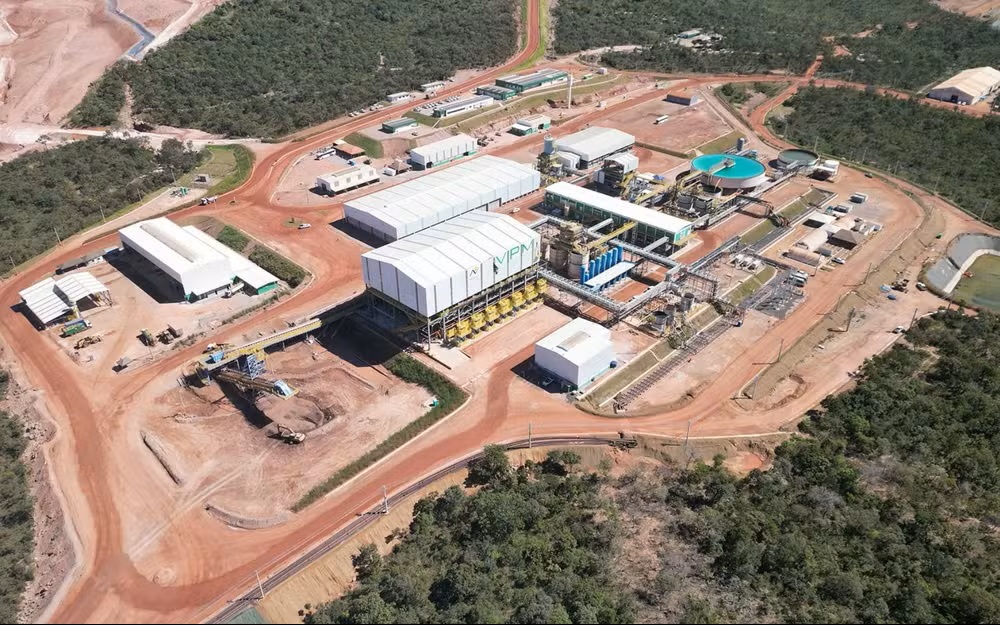
The two incentive packages from the Lula government aim to support companies like those in the Serra Verde Group, the Trump administration’s new bet for rare earth extraction in the country.
Direct American financing is seen as an attempt to reduce import dependence and the control that China exerts in the international market , and raises questions about Brazilian sovereignty in the sector.
At the same time, the Lula government made financial instruments available to dozens of companies , which will be offered by the National Bank for Economic and Social Development (BNDES) and the Financing Agency for Studies and Projects (Finep).
The two institutions are in the creation phase, with 56 companies pre-selected in a public call released in June 2025 for “joint support plans” with a total estimated value of R$ 45.8 billion .
This should be one of the final stages before the release of funds from the Brazilian state bank, which has 10 rare earth projects in its initial portfolio.
In addition to Serra Verde, companies with Australian capital, such as Viridis Mining & Minerals and Meteoric, with operations still in the pre-production phase in Minas Gerais, are also included in the same project.
For now, the amounts that each project may receive and the details of the business plans presented in the first selection phase have not been disclosed due to business confidentiality, according to BNDES.
Among the support options are “credit instruments, equity participation, non-reimbursable resources for cooperative projects between companies and technological institutions (ITs), and economic subsidies.”
The presentation of documents and information guaranteeing that these companies comply with the requirements of the Socio-environmental and Climate Regulation for Support to the Mining Sector , from the federal bank, and other Finep requirements, was also postponed to a second phase.
The second federal government project in this area is led by the Ministry of Finance. The Brazilian Platform for Climate Investments and Ecological Transformation (BIP) selected, among the rare earth proposals, the Meteoric project, with a potential investment of US$ 534 million. And, once again, the Serra Verde project, with a potential investment of up to US$ 300 million.
In the case of BIP, according to the federal government, there is no financial contribution to the projects. The purpose, according to the Ministry of Finance, is to establish “the connection between the projects and the financial institutions”.
These two endorsements from the Lula government, even if partial, including companies with foreign capital, are being given even before the definition of the National Rare Earth Strategy (ENTR). As highlighted by the Ministry of Mines and Energy in its announcement in January of this year, the initial step on the subject was taken with the beginning of technical work and the definition of goals and guidelines for the rare earth sector in the country.
According to Finep, the selection focuses on “intermediate and final processed rare earth products with added value and the establishment of links in the value chain of these elements in the country, as well as considering issues of scientific and technological autonomy.”
Insufficient safeguards and countervailing measures raise doubts among foreign capital.
Even with these safeguards and counterparties highlighted in Finep’s responses to the report, the first phase of selecting projects from foreign-owned companies that will receive loans from the Brazilian government still raises doubts among experts.
According to Edna Aparecida da Silva, a researcher at INCT-INEU, these federal government projects are not limited to financialization, as she highlighted in a recent article on the subject , but the search for funding shapes the concrete form of Brazilian insertion in the rare earth sector.
In their assessment, when strategic projects depend “heavily” on external capital, on going public, and on the expectations of global investors, this ceases to be a technical detail and becomes a political issue.
“The transformation of critical minerals into financial assets, even in the early stages of exploration, indicates that the prevailing logic tends to be that of financial appreciation, and not necessarily that of building an integrated national strategy for technological and industrial development,” he states.
The fact that these funding initiatives were launched even before ENTR is a concern for Douglas Carvalho Ribeiro, who holds a doctorate in Law from the University of Hamburg (Germany) and is a postdoctoral researcher at the same university.
“First, extraction is financed, then the strategy is considered. This reveals that the logic is market-driven, not industrial policy-driven. ENTR arrives as a subsequent framework for something that is already underway,” criticizes Ribeiro.
According to the researcher, the federal government’s projects are a repetition of a historical pattern, since BNDES has always been divided between being an instrument of industrial policy and being a bank for promoting the export of commodities.
“By selecting projects from foreign companies — Australian, American — for extraction, without clear conditions for technology transfer or vertical integration of the production chain, the bank is repeating the commodity pattern.”
According to Ribeiro, “risk is socialized” and profit “is privatized and sent abroad.” “It’s the logic of dependency operating with public money,” he says.

Mining causes “territorial asphyxiation,” argues professor.
Land reform settlements, indigenous lands, quilombola territories, and conservation units, considered Territories of Socio-environmental Interest (TIS), are experiencing “territorial asphyxiation” in Goiás due to the expansion of mining projects, especially rare earth mining.
This is the thesis defended by Ricardo Júnior de Assis Fernandes Gonçalves, a professor of Geography at the State University of Goiás (UEG), who studied the area where the mineral is being extracted by Serra Verde in Minaçu (GO).
As revealed by the Mining Observatory in July 2025 , there are 187 rare earth mining processes affecting areas in 96 Incra settlements. Bahia leads with 88 processes, followed by Goiás with 53, Pernambuco with 21, Paraíba with 8, and Minas Gerais with 6.
Of the total overlapping areas in the state of Goiás, 37 are related to processes in the name of Serra Verde, all registered during the research authorization phase at the National Mining Agency (ANM).
In other words, the company, which has already received funding from the billionaire United States government and is part of two support plans, some of which are also financial, from the federal government, is also at the center of a discussion that involves, among others, the Federal Public Defender’s Office (DPU).
The Public Defender’s Office (DPU) filed a Public Civil Action (ACP) in June 2025 to have the National Institute for Colonization and Agrarian Reform (INCRA) revoke Normative Instruction 112/2021, which allows mining in rural settlements.
“Research authorization titles represent the formalization of an interest in conducting studies to identify or evaluate potential mineral deposits. If these works are territorialized, impacts on landscapes due to the removal of vegetation and soils, on local ecosystems, and on the internal dynamics of the territories represent threats to the communities and peoples of the Cerrado region of Goiás,” assesses Gonçalves.
Last year, Serra Verde informed the reporter that it has no plans for the areas requested by the ANM (National Mining Agency) within the boundaries of the settlements. When questioned again about this and other issues related to the environment and environmental licensing, the company said it prefers not to comment.
Urgency could compromise environmental guarantees.
According to Luis Eslava, professor of International Law at the Faculty of Law of La Trobe University (Australia), the lessons from previous waves of extractivism, such as oil, gas and large-scale mining, are clear: ignoring environmental rights and limits produces long-term instability and social conflict.
“When minerals are presented as urgent strategic needs, governments may feel compelled to accelerate licensing processes and compress consultation timelines,” he says, referring to listening to local communities.
The Brazilian Mining Institute (IBRAM), for example, was one of the industrial organizations that advocated for changes in environmental licensing legislation to provide greater “agility” to projects considered strategic, which was in fact approved by Congress and the government. The proposal resulted in the relaxation of controls and the reduction of environmental safeguards in the name of competitiveness and economic urgency.
“The collapses of the Vale dams in Mariana and Brumadinho are striking examples of how the absence of rigorous regulation and effective oversight can generate human, social, and environmental damage of great magnitude,” assesses Edna Silva, from INCT-INEU.
According to Douglas Carvalho Ribeiro, recent history shows that rare earth processing entails a “huge environmental cost.” Ribeiro points out that the United States did not abandon its rare earth projects due to a lack of reserves, as the Mountain Pass mine in California is one of the largest in the world.
Projects in the United States therefore had an environmental cost due to processing that was “politically unsustainable” domestically. “China absorbed that cost. And now, with the attempt to diversify supply chains, Brazil is emerging as a new destination for this outsourcing,” he says.
In their assessment, core countries export environmental risk along with investment, especially now that the race for critical minerals has become a matter of national security for the US and China, and pressure on local governments to speed up licensing and reduce environmental requirements is increasing enormously.
“There is no extraction and processing without risk, and the question that should guide any serious policy in this area is: who assumes this risk? Until now, the answer has always been the same: the local populations and the Brazilian environment,” he adds.
Lucio Lambranho
Lucio Lambranho has been a reporter since 1996. He received an honorable mention in the Vladimir Herzog Award for reports on slave labor published on the Congresso em Foco website. He was one of those responsible for the reports on the airfare scandal, a journalistic series that won the Embratel Award for Investigative Journalism and the Esso Award for Best Contribution to the Press in 2009. He participated in investigations at Papel Social on slave and child labor and environmental damage caused by the production chains of sugar and sugarcane mills, carnauba wax, cocoa, construction, textiles, and recycling.