

Notícias
Banking on the Amazon
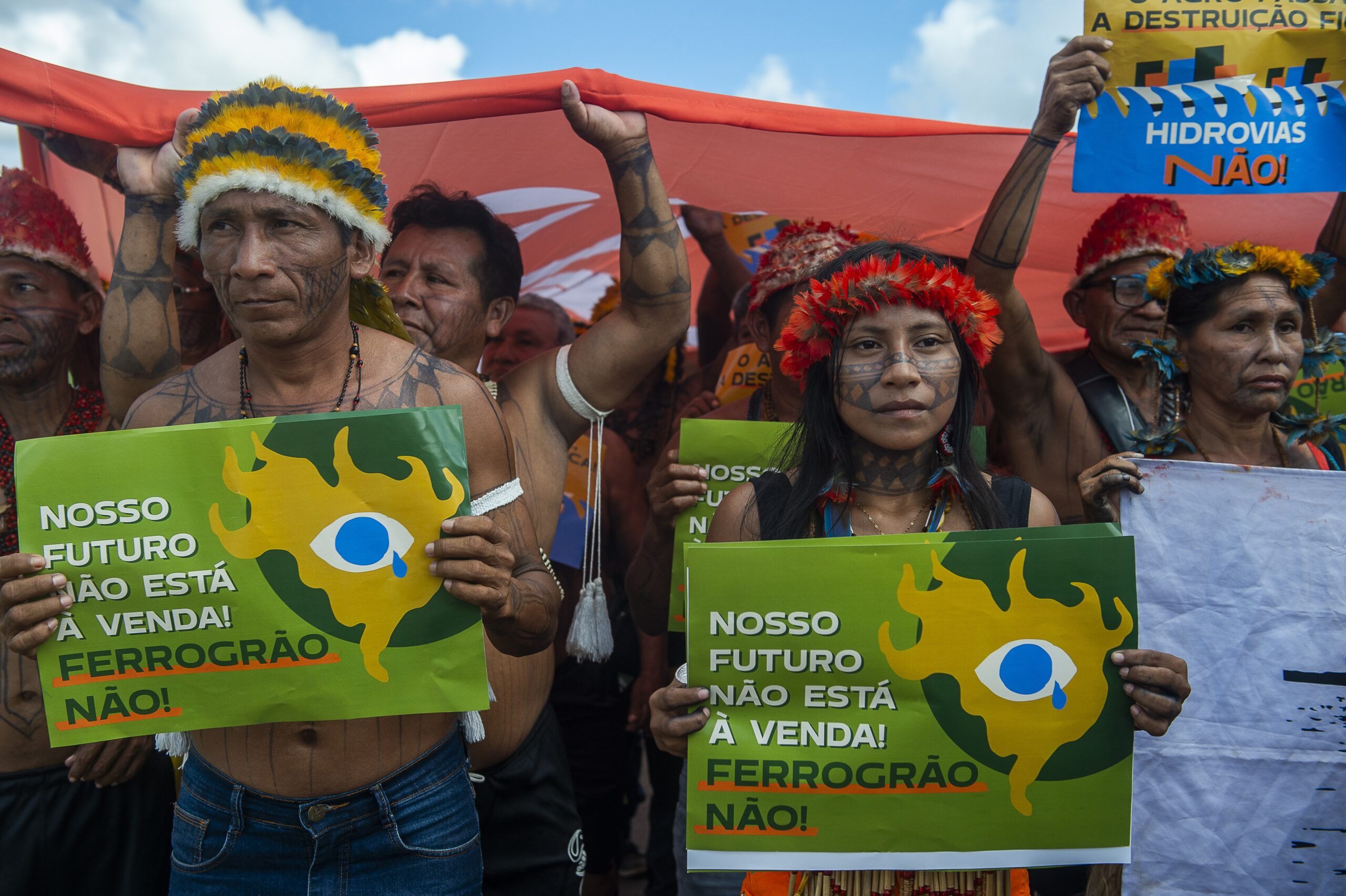
In a world on fire, a surprising bit of good news arrived early this year when we learned that deforestation in the Brazilian Amazon is on track to hit a record low, since 2014. This is due largely to the Lula administration’s enforcement of laws targeting illegal deforestation, alongside the impacts of global campaigning to hold companies and financiers accountable for driving deforestation, especially linked to beef and soy. The greatest share of the credit, though, has to go to the Indigenous Peoples’ movements, which stand steadfast in the face of the endless onslaught of threats. The incredible recent victory of Indigenous activists against a decree that would have given private companies unprecedented control over Brazil’s rivers, including those that feed the Amazon, is a testament to the strength and ferocity of Brazil’s Indigenous movements.
But these achievements come just as a new threat emerges: the big agriculture companies that sought to control Brazil’s rivers to transport their product to their Atlantic ports – the same companies who were the subject of massive protests by the Amazon’s Indigenous movements – stand to benefit from the rollback of one of the most important conservation agreements the region has ever seen.
On Earth Day, we’ll be taking action to help stop the threat.
In 2006, an agreement was forged between environmental groups, Brazilian authorities, agribusiness and consumer goods companies to refrain from purchasing soy grown on land in the Amazon rainforest. The resulting Amazon Soy Moratorium has been hailed as one of the most effective conservation achievements of recent decades. Researchers estimate that an area of rainforest the size of Ireland would have been lost to soy farms in Brazil without the moratorium and related conservation efforts. For nearly two decades, the Amazon Soy Moratorium provided safeguards to prevent soy-driven deforestation in the Amazon biome – and it worked. This voluntary agreement reduced deforestation by 69% between 2009 and 2022. Food companies, retailers, and their financiers relied on those safeguards to meet their own No Deforestation commitments.
But at the start of 2026, the industry group representing major soy traders – Cargill, ADM, Bunge, Louis Dreyfus, and Amaggi – formally withdrew from the Amazon Soy Moratorium. The companies withdrew from the agreement as Brazilian legislators, threatened to suspend tax breaks to companies adopting environmental criteria beyond those required by Brazilian law.
This looks bad – and it is bad. But all is not lost. The lion’s share of Brazil’s soy is exported, and the industry receives considerable financing from global banks – meaning that multinational companies could still be persuaded to maintain a ban on purchasing soy linked to deforestation in the Amazon, even if, for political expediency, they don’t formally say so in their sustainability policies.
One way to make this happen is to follow the money and urge the banks that finance these companies to maintain policies that protect the Amazon. According to Forests & Finance, between 2020 and 2025, Citi, JPMorgan Chase, Bank of America, BNP Paribas and Barclays Bank provided almost a billion dollars in loans and underwriting to Cargill, ADM, Bunge, Louis Dreyfus, and Amaggi’s Brazilian soy operations.
At the time, that financing would have been provided in part on the understanding that the Amazon Soy Moratorium would ensure deforestation-free soy from the region.
Today, that assurance has fallen through.
That’s why we’ve sent a letter to financial institutions alerting them that, without immediate action, their financing risks fueling large-scale soy-driven deforestation of the Amazon, pushing it ever closer to a devastating tipping point. In the absence of the Amazon Soy Moratorium, financing for the big soy traders could bring regulatory risks, market access risks, and reputational risks.
Those risks are bad for the banks. But far, far worse is the threat to the Amazon itself and the Indigenous Peoples who live there and have shaped and relied on the rainforest for millennia.
“If this protection disappears, the consequences will reach our rivers, our forests and our homes,” said Alessandra Korap Muburuku. “Soy does not grow under trees. It replaces them and brings pesticides that run into the water. It brings land grabbing and invasion and still more violence. We know, because we already live it. We do not eat soy, gold, or iron ore. We eat fish. We eat the fruits of the forest. We depend on the river and the land to live. When they are destroyed, we are destroyed with them.”
This Earth Day, we plan to deliver tens of thousands of petition signatures to the banks that have the power to prevent an uptick in Amazon destruction. In a time of terrible tragedies all around, maybe this action can help save a piece of the Amazon, before it’s too late.