
INSIGHTS
Assessment analysis
VOLUNTARY ACTION HAS FAILED,
IT'S TIME TO REGULATE FINANCE
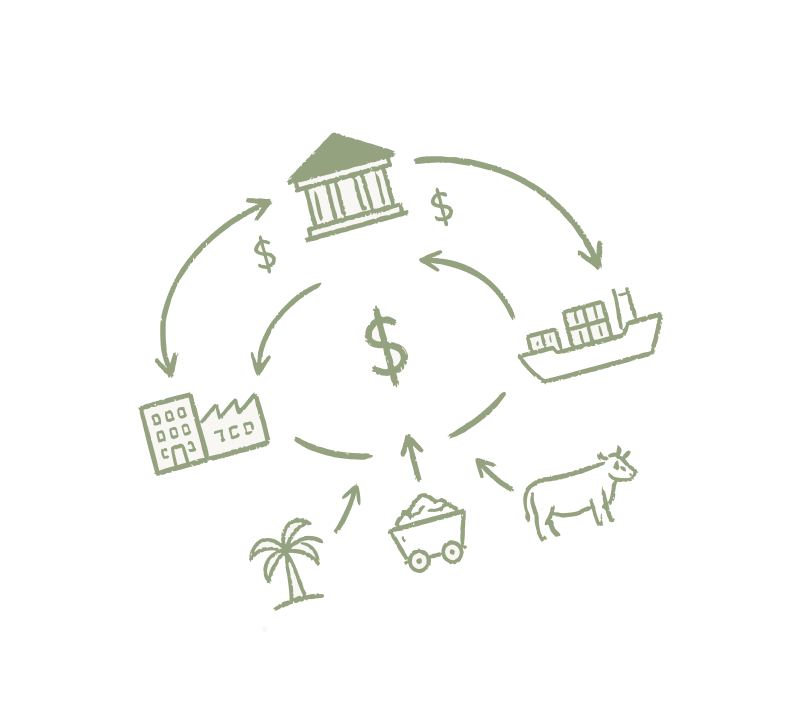
Forest-risk financing for agro-commodities is accelerating a decade after the Paris Agreement – 20% growth in the last year alone, 71% since 2016 – from 37.9 billion to 64.7 billion in 2025.

How do the bank & investor policies stack up? - Scores on soft commodity policy assessments of 50 financial institutions
See how the largest banks and investors enabling forest-risk commodity sectors in the worlds’ tropical forest biomes score. We assessed the strength of their Environmental, Social and Governance policies for key forest-risk sectors in 2023.
Institutions
102
2023 assessment
Average score
1.58
Overall
Top performer
5.63
Government Pension Fund Global
Highest block
5.72
Government Pension Fund Global
OUR DEMANDS TO THE FINANCIAL SECTOR
Governments and financial institutions need to act now to address the climate and biodiversity crises. To achieve this, they should adopt and implement these five principles:
1
Halt and reverse biodiversity loss.
2
Respect and prioritize the rights of Indigenous Peoples, women and local communities.
3
Foster a socially and ecologically just transition.
4
Align institutional objectives across sectors, issues, and instruments.
5
Ensure ecosystem integrity.
MAJOR AGRO-COMMODITY PRODUCING COUNTRIES
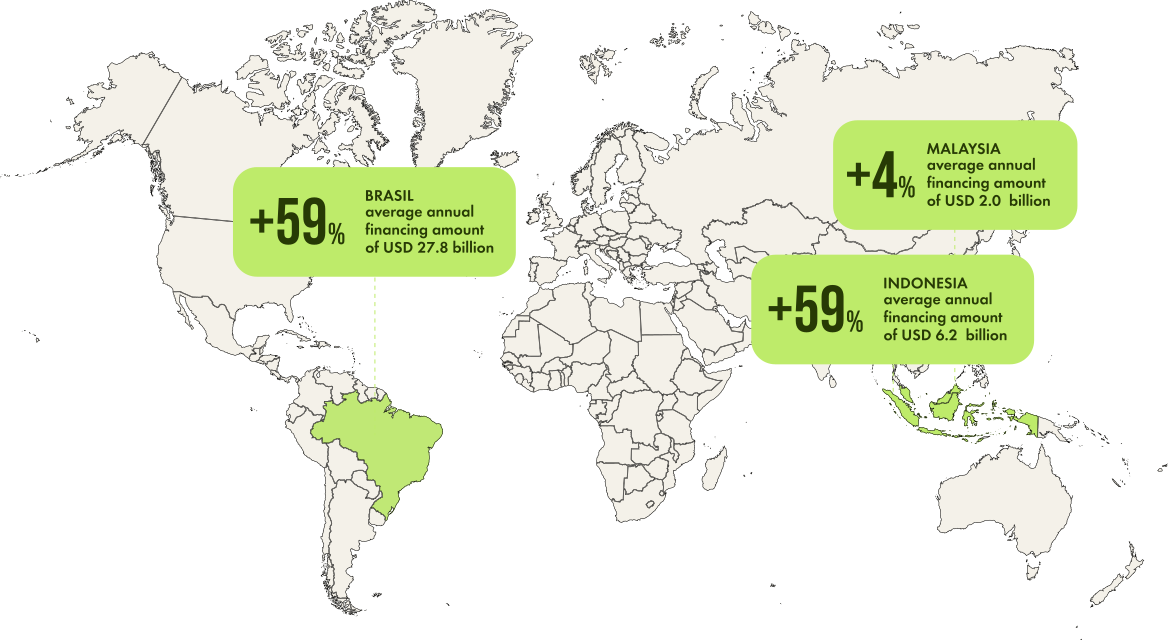
Brazil, Indonesia and Malaysia – have increased average annual financing in the last decade. Brazil and Indonesia both increased by +59% up to an average annual financing amount of USD 27.8 billion and USD 6.2 billion respectively, and Malaysia +4% up to USD 2.0 billion per year.
BEEF, SOY AND PULP AND PAPER
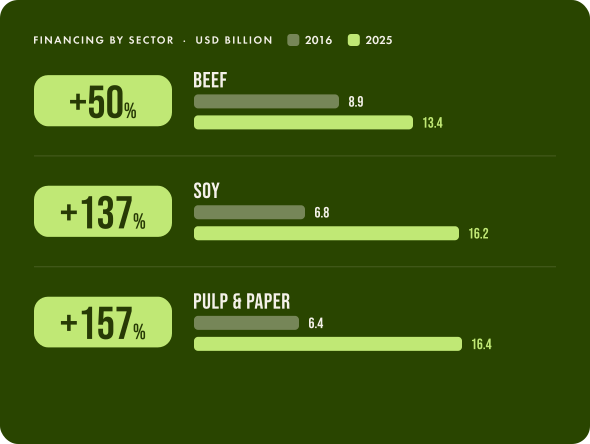
Three of the largest agro-commodity sectors – had major financing increases between 2016 and 2025. Beef financing rose +50% to USD 13.4 billion, soy increased +137% to USD 16.2 billion despite the collapse of the Amazon Soy Moratorium, and pulp & paper, a sector linked to peatland degradation and fire-risk in Indonesia increased +157% to USD 16.4 billion.
METAL & MINERALS
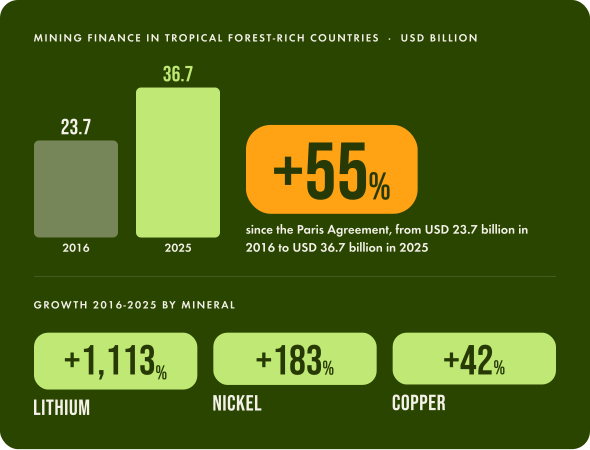
Financing for metal/mineral mining in tropical forest-rich countries has surged, +55% since the Paris Agreement from USD 23.7 billion in 2016 to USD 36.7 billion in 2025.
Between 2016 and 2025, Lithium increased +1,113% up to USD 2.0 billion, nickel +183% up to USD 1.6 billion, and copper +42% up to USD 20.6 billion.
FINANCIAL INSTITUTIONS
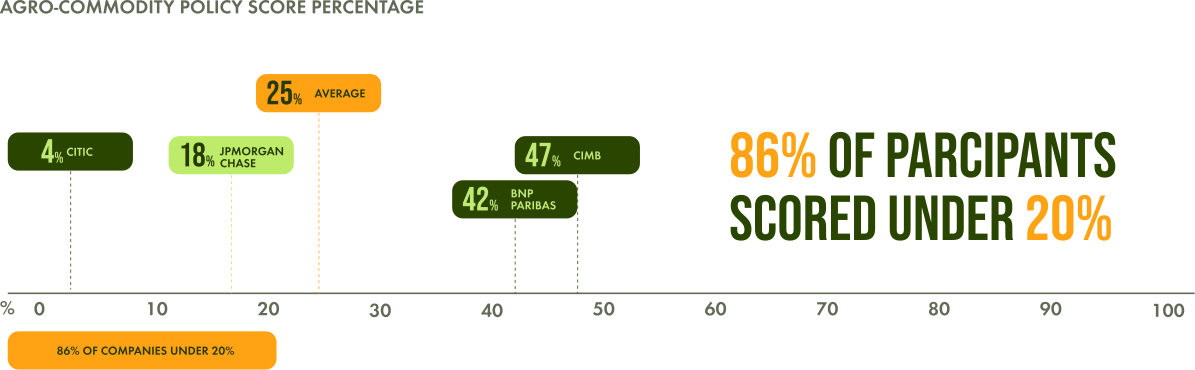
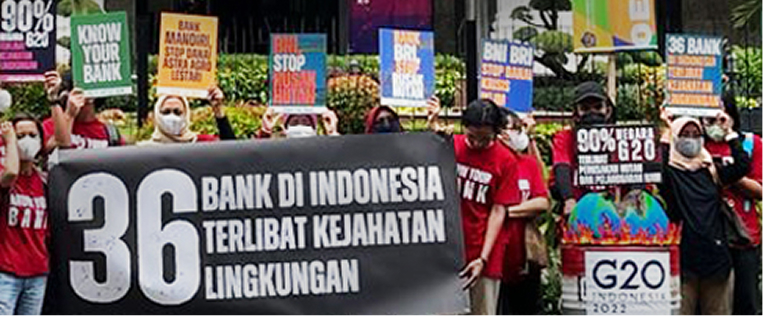
Banks' agro-commodity policy safeguards are inadequate across the board, and the worst performers include some of the sector's biggest financiers. The average score of assessed banks is 25%, ranging from 4% for the Chinese state-owned CITIC to 47%. Only two banks – CIMB (47%) and BNP Paribas (42%) – scored above 40%, while 12 scored below 20%, including JPMorgan Chase, the world's largest bank, at just 18%.