
October 21, 2026
New Assessment Finds Financial Regulators Failing to Turn Biodiversity Commitments into Binding Rules
By Forest & Finance
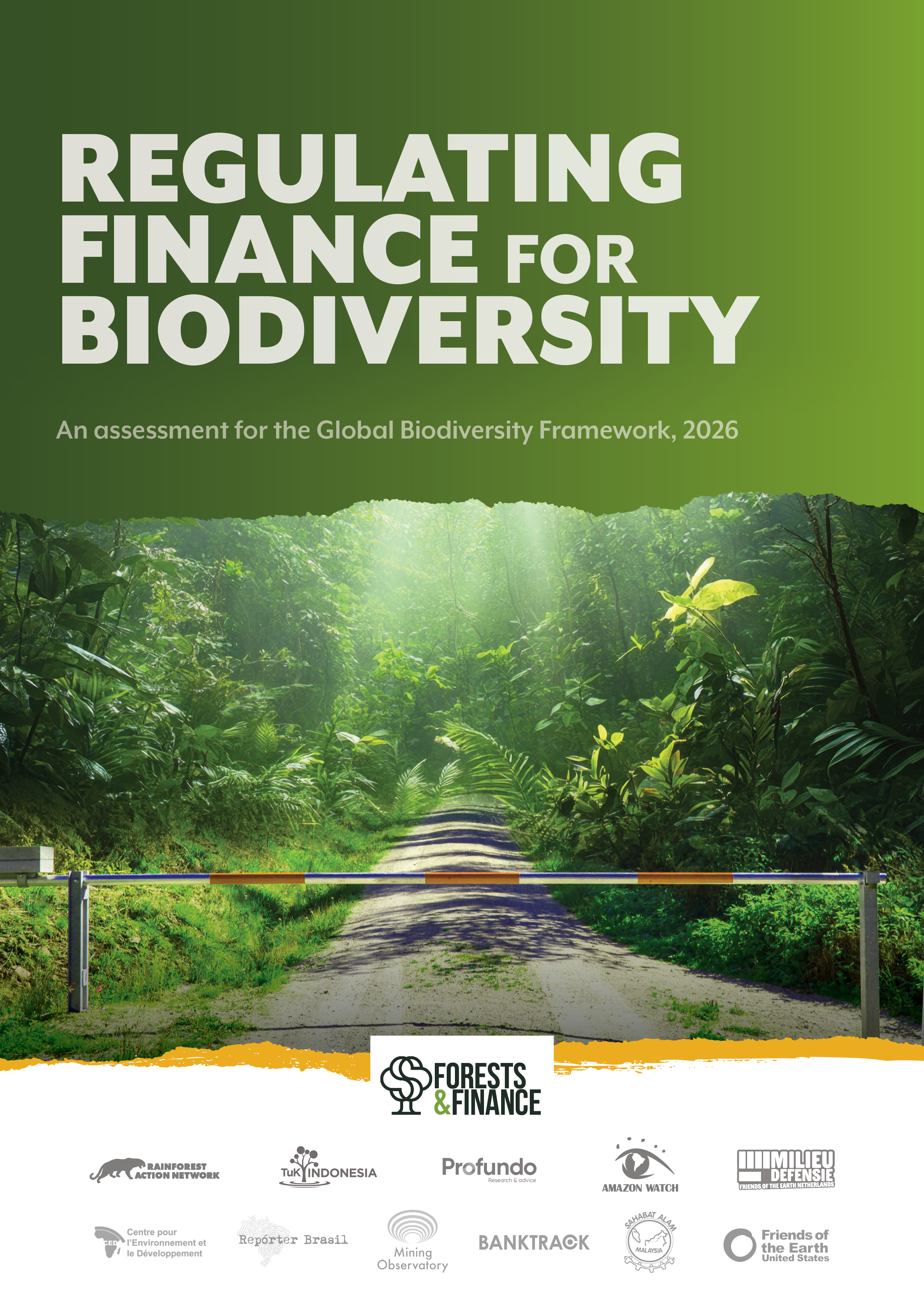
Global review of 11 strategically important financial jurisdictions finds no comprehensive restrictions on financing deforestation and ecosystem conversion ahead of UN biodiversity summit
YEREVAN, Armenia — October 21, 2026 — Four years after governments agreed to align public and private financial flows with global biodiversity goals, a new assessment finds that major financial jurisdictions have yet to translate those commitments into binding rules capable of stopping finance for deforestation and ecosystem destruction.
The report, Regulating Finance for Biodiversity: An Assessment for the Global Biodiversity Framework 2026, examines financial regulation in 11 jurisdictions that play a strategically important role in the financing of forest-risk industries: Brazil, Canada, the Central African Economic and Monetary Community, China, the European Union, Indonesia, Japan, Malaysia, Singapore, the United Kingdom and the United States.
Across the three criteria applied in each of the 11 jurisdictions, none achieved the report’s highest green rating: 30 of the 33 ratings were red or dark red and only three were yellow. Most strikingly, the researchers found that no jurisdiction comprehensively prohibits banks or investors from financing companies involved in deforestation or the conversion of natural ecosystems.
The findings are being released as governments meet in Yerevan for COP17 of the UN Convention on Biological Diversity, the halfway point between adoption of the Kunming-Montreal Global Biodiversity Framework in 2022 and its 2030 targets.
“Governments made a commitment to align finance with global biodiversity goals, but that promise has failed to reach the rules governing banks and investors,” said Merel van der Mark, Forests & Finance Coalition Coordinator. “Financial institutions are increasingly being asked to disclose nature-related risks, but they are still largely free to finance the destruction those disclosures describe. Transparency matters, but disclosure without rules governing where money flows will not stop deforestation.”
The Global Biodiversity Framework’s Target 14 calls on governments to progressively align public and private financial flows with its goals and targets. The new report, by the Forests & Finance Coalition, examines whether financial regulation is beginning to deliver on that commitment.
It finds a wide gap between international biodiversity pledges and the rules governing lending and investment. While biodiversity is appearing more frequently in financial disclosure frameworks, taxonomies and risk-management policies, binding requirements affecting entire financial portfolios remain rare.
Among the report’s key findings:
Financing ecosystem destruction remains largely unrestricted. None of the 11 jurisdictions comprehensively prohibits financial institutions from financing or investing in companies involved in deforestation or natural ecosystem conversion.
Disclosure is advancing faster than accountability. Reporting requirements are emerging in several jurisdictions, but no jurisdiction requires full transparency of financing and investment flows together with comprehensive disclosure of their biodiversity and social impacts.
Biodiversity remains largely absent from monetary policy. Central banks have begun incorporating climate considerations into some operations, but biodiversity is rarely reflected in collateral frameworks, refinancing, asset purchases or other monetary policy tools.
Just-transition requirements are largely missing. Financial regulations generally do not require banks and investors to ensure that transitions in agriculture, forestry, fisheries and other high-risk sectors protect Indigenous Peoples, local communities, workers and small-scale producers.
Some jurisdictions are moving backwards. The report identifies regulatory rollbacks or stalled reforms in several markets, including the United States and European Union.
The regulatory gap is particularly significant because of the scale of finance continuing to flow to industries linked to tropical forest destruction. Forests & Finance identified USD 894 billion in forest-risk-adjusted loans and underwriting between January 2016 and September 2026: USD 531 billion connected to agro-commodities and USD 363 billion to metal and mineral mining. USD 595 billion was provided from 2020 onwards.
“Based on financial materiality principles, regulators are trying to protect banks and investors from risks caused by nature loss while doing almost nothing to protect nature and people from the impacts of bank and investor financing decisions,” said Jan Willem van Gelder, Director of Profundo. “That imbalance must end. Financing biodiversity destruction should carry real regulatory consequences.”
The report finds significant differences among jurisdictions, but no clear leader.
Brazil has some of the strongest targeted restrictions, including limits on government-controlled rural credit linked to illegal deforestation, protected areas and Indigenous lands, but those safeguards do not extend across ordinary bank lending and capital-market products.
Indonesia requires financial institutions to prepare Sustainable Finance Action Plans, has strengthened biodiversity criteria in national taxonomy, and benefits from the regional ASEAN taxonomy, but these measures do not require full portfolio alignment or prohibit financing linked to ecosystem conversion.
China is moving toward mandatory corporate sustainability reporting by 2030, including some biodiversity considerations, but those requirements have not yet translated into systemic rules requiring financial institutions to redirect capital away from damaging activities.
The European Union has developed the most extensive sustainable-finance architecture among the jurisdictions reviewed, but key nature-related rules still insufficiently cover the financial sector itself, while recent regulatory changes have narrowed or delayed elements of corporate sustainability reporting and due diligence.
The United States stands out in the report for regulatory reversal, following the withdrawal of interagency climate-risk principles, the dismantling of climate-related structures within the Federal Reserve and proposed rescission of federal climate disclosure rules.
The report argues that closing the gap will require governments to move beyond voluntary guidance and product-level sustainability labels toward binding rules governing entire lending and investment portfolios.
Among its recommendations are requirements for banks and investors to disclose financing flows and their biodiversity impacts; mandatory due diligence for financing linked to deforestation and ecosystem conversion; biodiversity criteria in prudential regulation and central bank operations; time-bound portfolio alignment targets; strong protections for Indigenous Peoples and local communities, including Free, Prior and Informed Consent; and effective sanctions where financial institutions fail to comply.
“Governments cannot keep financing biodiversity destruction with one hand and expect funding for protection with the other to compensate,” said Tom Picken, Forests & Finance Policy Director at Rainforest Action Network. “The Global Review at COP17 must put harmful financial flows at the centre: regulating the much larger flows driving destruction, while also delivering the finance needed to protect and restore biodiversity.”
Regulating Finance for Biodiversity: An Assessment for the Global Biodiversity Framework was researched by Profundo and commissioned by Rainforest Action Network on behalf of the Forests & Finance Coalition.
About Forests & Finance
Forests & Finance is a coalition of campaign, grassroots, journalistic and research organisations working to expose and prevent financial-sector support for tropical deforestation and associated human rights abuses. The coalition maintains an open-source database tracking financing to companies involved in forest-risk commodities and conducts research, investigations and advocacy aimed at holding financial institutions accountable.
Download the full report
Download the Executive Summary