
October 14, 2026
New Global Analysis Finds Banks Pumped USD 595 Billion into High-Risk Agribusiness and Mining in Tropical Forest Regions Since 2020
By Forest & Finance
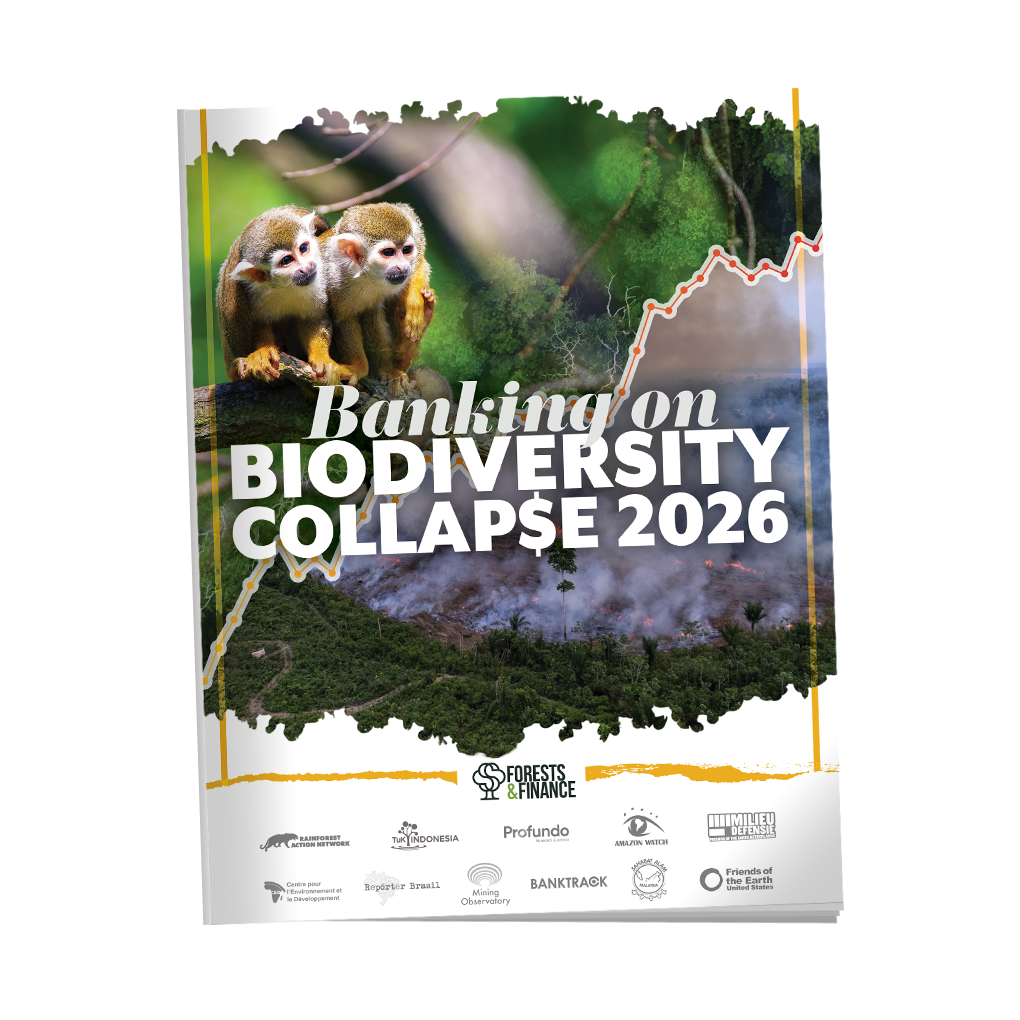
First combined analysis of agribusiness and mineral mining financial flows exposes growing biodiversity impacts from banks and investors
AMSTERDAM, October 14, 2026 — The world's largest banks and investors continue to finance companies driving tropical deforestation, ecosystem destruction and human rights abuses while failing to adopt safeguards capable of preventing those harms, according to a major new report released today by the Forests & Finance coalition.
Published during the UN Principles for Responsible Investment (PRI) conference in Amsterdam, just days before governments gather in Armenia for the UN Biodiversity Conference (COP17), Banking on Biodiversity Collapse 2026 is the largest global analysis of harmful biodiversity finance to date. The report examines financing for companies operating across the world's tropical forest regions and raises the urgent need to connect financing decisions to real-world impacts and close the accountability gap which enables banks to continue to finance harm.
For the first time, the coalition's annual report analyzes financing for metal/mineral mining in the tropical forest basins, reflecting the rapid expansion of nickel, lithium, cobalt and copper production into many of the world's most biodiverse regions. This year’s report also expands its focus to include coffee and cocoa as forest risk commodities. The report argues that banks are increasingly financing two of the biggest drivers of biodiversity loss—industrial agriculture and large-scale mining—without requiring safeguards that adequately protect forests, freshwater and marine systems, as well as the rights of Indigenous Peoples and local communities.
"Forests, rivers and reefs aren't optional extras – they're the support systems the economy and life itself depend on. But banks are financing their collapse anyway," said Stephanie Dowlen, Senior Forest Campaigner with Rainforest Action Network. "We have to close the accountability gap and build food and energy systems that can actually function over the long term, not ones that destroy the foundations we all depend on."Among the report's findings:
Banks issued US$531 billion in credit to companies operating in high-risk tropical agro-commodity sectors since 2016.
For the first time in this report, Forests & Finance documents US$363 billion in bank financing for metal/mineral mining across tropical forest regions, since 2016.
The average score for bank policies covering financing for forest-risk agro-commodities remains just 25%, revealing major gaps in public commitments towards the protection of human rights and biodiversity.
The report documents continued financing for companies operating in sectors linked to deforestation, peatland destruction, fires, pollution and the violation of Indigenous Peoples’ rights across South America, Southeast Asia, and Central and West Africa.
Coffee and cocoa have been added to the coalition's annual assessment, reflecting growing concern over deforestation and labor abuses associated with those sectors.
The report comes as governments prepare to review implementation of the Kunming-Montreal Global Biodiversity Framework at COP17. “Countries have committed to aligning public and private financial flows with biodiversity goals. With the current voluntary commitments from financial institutions, they are not on track to meet that goal. Financial institutions must strengthen their policies and governments must increase regulation to ensure financial flows are aligned", said Merel van der Mark, coordinator of the Forests & Finance Coalition.
The report highlights several emerging risks across sectors.
In Brazil, banks continue financing major soy traders following the collapse of the Amazon Soy Moratorium earlier this year, weakening one of the world's most successful voluntary forest protection agreements. In Indonesia, financing continues to support plantation models associated with deforestation, peatland drainage and increasingly severe fires that have blanketed Southeast Asia in hazardous haze during 2026.
At the same time, demand for minerals is accelerating rapidly as governments and companies pursue the global energy transition and expand artificial intelligence infrastructure. The report warns that without stronger safeguards, the rush to secure supplies of nickel, lithium, cobalt and other minerals risks repeating many of the same environmental and social failures that have accompanied agricultural expansion into tropical forests.
The rapid expansion of high-risk mining operations in tropical forest regions is fuelling a new wave of destruction as communities face landgrabbing and widespread contamination, workers suffer dangerous conditions and forests are cleared, often under the banner of the "green", "clean" transition. Financial institutions are responsible for due diligence on their clients and must be held accountable for human rights violations they have helped finance.
The coalition is calling on governments attending COP17 to strengthen financial regulations requiring banks and investors to conduct robust biodiversity and human rights due diligence, improve transparency around financing for high-risk sectors, and hold financial institutions accountable when their financing contributes to environmental destruction or rights abuses. It also calls on banks to strengthen no-deforestation or conversion, no peatland development and no exploitation (NDPE) requirements, independently verify client compliance, and end financing relationships with companies that repeatedly violate those standards.
The report was produced by the Forests & Finance coalition, an initiative of Rainforest Action Network, TuK Indonesia, Profundo, Amazon Watch, Milieudefensie, CED Cameroon, Repórter Brasil, Observatório da Mineração, BankTrack, Sahabat Alam Malaysia and Friends of the Earth US.
Download the report